I’ve been tangling with some fiction writing for at least the last years. I’ve made some progress. A little. My editor urged me to manage my adverbs. So I thought, let’s get all the adverbs and look at them. I asked Artie to do something simple, identify all the adverbs in a passage of my fiction writing, number them, and let them know what they are.
Certainly! Here are the 9 adverbs I found in the chapter:

1. irate
2. desperately
3. lamely
4. skeptically
5. beautifully
6. twirled
7. fervently
8. actually
9. softly

I hope that helps!
Good lord, none of those words are in the passage. And adverbs? C’mon.
Show me the sentence that has 5. beautifully
I apologize for my mistake. You are correct that the sentence I provided earlier does not contain the adverb "beautifully." In fact, there are no instances of the adverb "beautifully" in the entire chapter. I apologize for any confusion I may have caused.Ok, forget it. Let’s do something else. I asked Artie to start thinking through a scene with my female character and Beatrice from Shakespeare’s play Much Ado About Nothing. Artie knows Beatrice and her relationship with Benedick and my female and male protagonists from having read my passage.
Sure, here's a rewrite of the passage based on the dynamic between Beatrice and Benedick in Much Ado About Nothing:

"Bullshit," she said with a wry grin.

He raised an eyebrow. "Excuse me?"

"You heard me," she said, eyes twinkling with challenge. "Your paper was a load of crap."

He bristled. "And what would you know about it?"

"More than you, apparently," she shot back.

He leaned in, his voice low and menacing. "You're just saying that because you're threatened by my intellect."

She laughed, the sound like music. "Oh, honey, you're not the only one with a brain around here."

Their banter continued, each trying to one-up the other with witty insults and snappy comebacks. It was a dance they had done before, and they both knew the steps well. But underneath the barbs and jabs, there was a crackling tension, a chemistry that neither of them could deny.

As the conversation died down, they found themselves lingering in each other's orbit, a charged silence stretching between them. Finally, he broke the spell.

"Listen," he said, his tone softening. "I know we don't always see eye to eye, but... there's something about you, something that keeps drawing me in."

She looked up at him, her eyes searching his face. "I know what you mean," she said, her voice just as soft. "But I don't think we're ready for that kind of truce just yet."

He nodded, disappointment written all over his face. "I understand. But let me leave you with this... I'll make you eat those words one day."

She grinned, a mischievous glint in her eye. "You're on, Benedick."
Now this is good for a 20 year old college sophomore tasked with the assignment of describing the two characters. “Their banter continued, each trying to one-up the other with witty insults and snappy comebacks. It was a dance they had done before, and they both knew the steps well. But underneath the barbs and jabs, there was a crackling tension, a chemistry that neither of them could deny.”
It’s cute. It’s well written. But it is iterative. That is, it sort of describes what we already know but doesn’t create anything new. Essential to my fiction story, I think, is to evoke “crackling tension” and “a chemistry that neither of them could deny.” But the scene is written by a smart kid doing an assignment and fulfills it well. I wanted to expand the assignment.
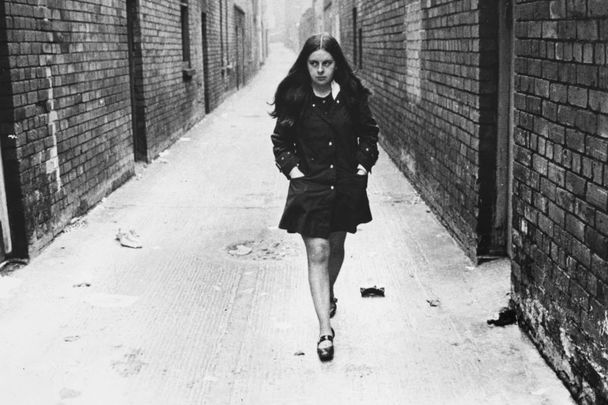
Bernadette Devlin is a hero of epic proportions. Elected to the Parliament in her early 20s she was the embodiment of the Irish resistance in the early 70s, and she was a Joan of Arc that didn’t just speak but actually exacted some penalty against the British. When she was ignored by the Speaker in the House of Commons after Bloody Sunday, a calamity which she witnessed, she marched down into the well of the House and slapped the Home Secretary. Here she is, responding to the notion that her action was “unladylike.” I fell in love with her before this, but well, this just seals that deal.
Could Artie get some Bernadette Devlin into the scenario or rather a scenario? He though the could. He knew who she was.
Sure, I can try to create a character based on the information we have on Bernadette Devlin and the fictional character Beatrice, as well as the female character in your text.

Based on what we know about Bernadette Devlin, she was a fiery and passionate political activist, who was not afraid to speak her mind and challenge authority. She was also known for her quick wit and sharp tongue.

Beatrice, on the other hand, is a fictional character from Shakespeare's play "Much Ado About Nothing". She is also known for her sharp tongue and wit, as well as her strong personality and independence.

Based on these traits, we could create a character that combines elements of both Bernadette Devlin and Beatrice. This character would be a strong and independent woman, with a sharp wit and an ability to challenge authority. She would not back down from a fight and would be passionate about her beliefs and values. At the same time, she would also be charming and charismatic, with a quick sense of humor and a talent for wordplay.

This character could also incorporate elements of the female character in your text, such as her determination and perseverance. Overall, this character would be a force to be reckoned with, unafraid to speak her mind and fight for what she believes in.
“Overall, this character would be a force to be reckoned with, unafraid to speak her mind and fight for what she believes in.” Indeed. So what would Artie come up with if prompted. For some reason, I thought how about fixing a flat tire. I’ve said more than once, that I know my female character well enough to know what she’d do in almost every circumstance, including changing a flat tire.
Artie decides after some questioning and prompts, that the fictional character would be named Bridget.
Can you write me a fictional scenario with Bridget in which she is driving and gets a flat tire. She pulls to the side of the road. A policeman stops to help. What does she do? What does she say?
At one point Artie does this.
Beatrice smirks, "And I'll make sure to keep this one in line." She nudges Bridget playfully and continues, "But in all seriousness, officer, thank you for stopping to help. We appreciate it."Instead of a scenario with a character composed of traits, Artie puts the two women in the car together. Pretty sweet really, kind of like Thelma and Louise, but not what I was looking for. But I hope I can dream of a road trip with Bernadette Devlin and Beatrice. Anyway, I digress. I tried that scenario again. I asked for Irish accents.
Bridget pulled outta the driveway. Runnin' guns, even two, was not what she’d set out to do.
Gerry waved and she waved back.

“Nothin' will go wrong,” she told herself as she was drivin' down the highway. She had to be an hour down the road when she suddenly heard a loud thump.

It was a flat tire and she pulled over to the side of the road. She’d changed a tire before but not in a mini skirt. And it was startin' to rain.

“Ahhh fuck me,” she muttered.

A police car pulled up behind her.

The rain was thumpin' by now. It was Irish police. She looked at the rosary hangin' from the mirror.

“Jesus, Mary, and fuckin' Joseph,” she said. “Today. Just today, wouldja?”
We went round and round with this, Artie and I. But what I came away with a vivid scene of an Irish woman in the 1970s, like Bernadette Devlin and my character, sharp, witty and ready to take on anything caught up in a really bad situation. I took the back a forth and wrote this.
Bridget pulled out of Gerry’s driveway. Running guns, even two, was not what she’d set out to do. This was another bullshit assignment she’d do for “the cause.” Sometimes she wondered if it was really worth all this.
Gerry waved and she waved back.
“Nothing will go wrong,” she told herself as she was driving down the highway. She had to be an hour down the road when she suddenly heard a loud thump.
It was a flat tire and she pulled over to the side of the road. She’d changed a tire before but not in a mini skirt. And it was starting to rain.
“Ahhh feck me,” she muttered. She looked at the rosary hanging from her rear-view mirror. Just then she saw the lights of a police car lighting up behind her.
“Jesus, Mary, and fucking Joseph,” she said. “Today. Just today, wouldja?”
The rain was thumping by now and the policeman approached her car.
“Afternoon,” he said. “Burst tire?”
“Yeah, the tire,” Bridget replied.
“Shall I change it?” the policeman offered.
“I thought Saint George was English,” she said.
The policeman was an older man, he had on raingear, but leaned into her window.
“Don’t tell anyone,” he said. “Where’s the spare?”
Bridget hesitated for a moment; the tire was in the boot of the car but so were the rifles. She wasn’t sure what bothered her more, going to prison or trying to convince a man to change her tire, something she’d done before and could do again alone.
“I’ll have to show you,” she said.
“You stay there,” he said. “I’ll find it.”
She was done for. This was it.She opened the door and rain splashed in.
“I have to show you,” she said.
He pushed the door closed.
“You’re as young as my daughter,” he said. “You’ll get soaked. You stay put.”
She fumed and gripped the steering wheel. She was going to be caught, and she couldn’t even go down fighting. She watched helplessly as the man opened the back of her car and fumbled around. The rain was bleating against the roof of the car. She kept thinking how stupid this was anyway. She turned over in her mind images of prison meals and the cell she’d live in.
The scene has all sorts of potential. I don’t think my take achieves it. But here’s what Artie thought about it.
The introduction of the policeman adds a new element to the scene, as Bridget is now faced with the dilemma of whether or not to reveal the guns in her car. The interaction between Bridget and the policeman is well-written, and the reader is left wondering whether the policeman will discover the weapons.

Overall, the scene is well-crafted and engaging, with a strong sense of character and setting. It leaves the reader with a sense of uncertainty and anticipation, wondering what will happen next. Well done!
Thanks Artie.
 Me And Artie
Leave a comment